
Durham City Directory Shelf
Durham County Library describes its city and county directories as annual snapshots of residents and businesses. The collection has two useful arrangements: an alphabetical section for a name-first search and a street-address section for an address-first search. The runs below are collection coverage, not a promise that every issue survives, is complete, or has searchable text. Keep the edition year with every note. That date is what turns an address or phone listing into historical evidence rather than a claim about the present.
| Collection | Years | Where Held | Access |
|---|---|---|---|
| Durham city and county print directories | Annual print back to 1903; late nineteenth-century issues back to 1892 | Durham County Library North Carolina Collection | Consult the collection before a visit |
| DigitalNC Durham directories | Approximately 1875-1963 | DigitalNC | Online scans; confirm edition and page |
| Mangum's Directory of Durham and Suburbs | Dates vary by held issue | North Carolina Collection | Useful beyond the city frame |
| Telephone directories | 1927 and 1950-2016 | North Carolina Collection | Historical phone and address evidence |
| Greater Durham Area Cross Reference Directories | 1962-present | North Carolina Collection | Telephone and street-address information |
The Durham County Library directory guide is the best starting point for matching a research question to a run. A person who appears in one issue may be omitted in the next, and an address may be a business, boarding arrangement, or household entry.
See the official Durham directory collections before choosing a volume.
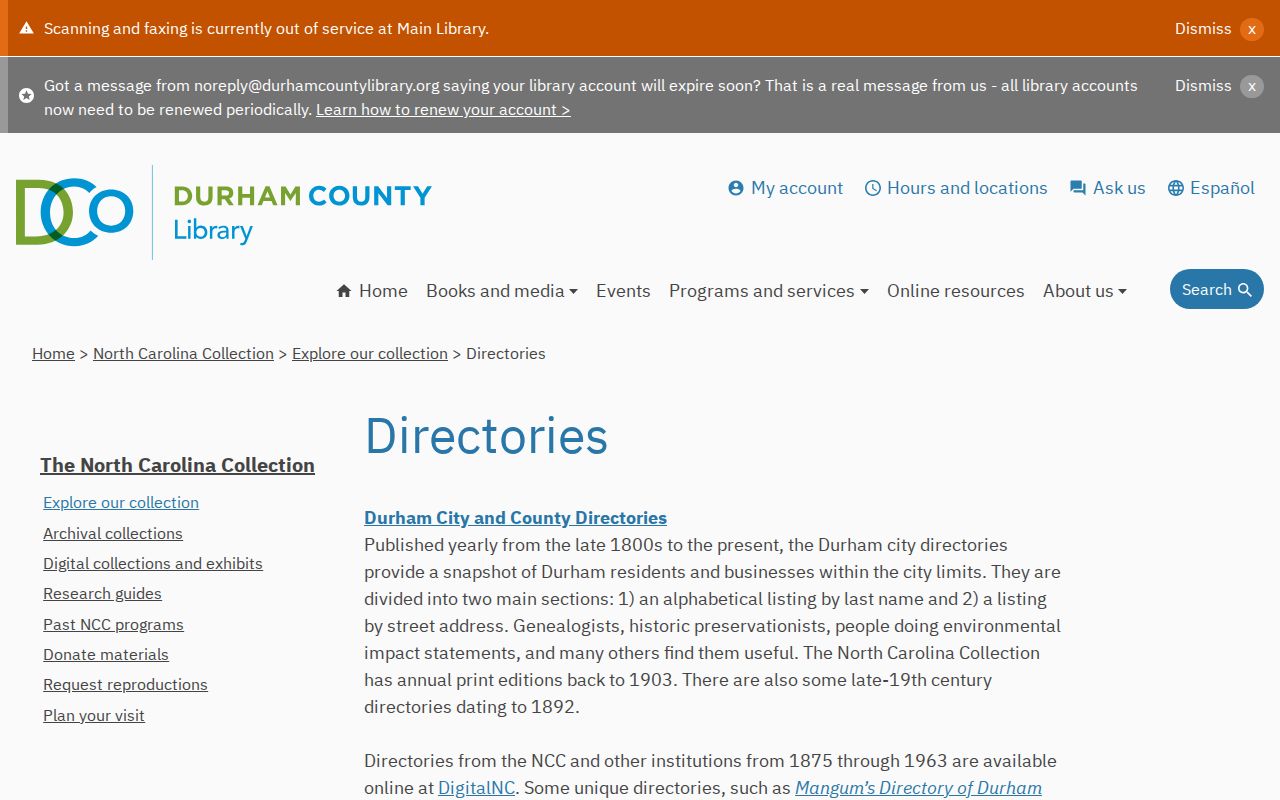
The collection page helps separate the annual books, telephone volumes, and cross-reference material before a name is treated as one kind of record.
Durham City Directory Formats
A surname section answers, “Was this name printed in this edition?” A street section answers a different question: “What listings appear at this address or nearby in this edition?” Those two paths are complementary. The entry can include a surname and initials, an occupation or business, a street address, a street section, a telephone number, and the edition year. Advertisements and business indexes can add commercial names and local geography, but an advertisement is promotional material, not proof that every proprietor or resident was listed.
Mangum's Directory of Durham and Suburbs is especially useful when a family story extends beyond a narrow municipal frame. The telephone and Greater Durham cross-reference volumes are later formats with different strengths. A historical phone number can be reassigned, and an address in a directory may be a work or business location. Use the source type and the printed year to describe what the listing actually supports.
Note: A missing listing can reflect a variant spelling, initials, an incomplete issue, or a different listing convention, not necessarily a move.
Durham City Directory at Main Library
The North Carolina Collection is on the third floor of the Main Library, 300 N. Roxboro Street, Durham, NC 27701. Its listed hours are Monday through Saturday, 10 to 4, and it is closed Sunday. Library staff can be reached at 919-560-0171 or ncc@dconc.gov. The collection also holds Durham Herald-Sun microfilm, old school yearbooks, genealogy resources, local-history material, and guides to outside collections. Those companion sources are useful after a directory yields a name, address, or institutional connection.
Plan ahead for a particular edition. The library invites advance questions and reproduction requests, so ask whether the desired directory year, page condition, microfilm, and reproduction option are available. The answer may be a shelf volume, a scan, a microfilm reel, or a referral to another holding institution. That is more reliable than assuming an annual title is online or that every page can be copied.
Use the North Carolina Collection's Main Library page to confirm current access details.
The local-history setting matters because the same visit can combine directory pages with newspapers, yearbooks, and staff guidance on related holdings.
DigitalNC Durham Directory Scans
DigitalNC supplies Durham directory scans from approximately 1875 through 1963. A scan is convenient for trying surname variants and looking at a street section without a trip, but scan quality and text recognition can vary. Check the title page, edition year, and page itself before copying a line into a family file. The research pass did not establish a precise printed name or address from the sample PDF, so no sample person should be inferred from the image capture alone.
Durham County Library's external resources guide links the directory work to DigitalNC and a wider network of local papers, university collections, photographs, museums, and history resources. Item-level indexing and reuse rules vary across those sources. Ask the holding collection about a finding aid, visit, or reproduction request instead of using a public-records request for a manuscript collection.
The Durham historical resources page shows the wider research network around city directory work.
These linked collections can add institutional or neighborhood context after a city directory gives the first time and place anchor.
Durham Directory Years in Context
Durham's directory shelf reaches into the period before Durham County formed in 1881. That matters when a nineteenth-century person or parcel seems to disappear from later county records. The event may belong to a predecessor county, an early directory, or an archive collection rather than a present-day county office. County formation is a jurisdiction clue, not a reason to treat the full historical record as lost.
- About 1875-1963: DigitalNC's documented Durham scan range.
- 1877/78: Beveridge's North Carolina State Directory lists Durham businesses, owners, and advertisements.
- 1881: Durham County formed from parts of Wake and Orange counties.
- 1886: Charles Emerson's Tobacco Belt Directory includes Durham County businesses, professionals, and landowners.
- 1892 and 1903: late nineteenth-century issues reach back to 1892, while annual print directories are reported back to 1903.
The Durham County history source provides the county chronology behind that jurisdiction check.
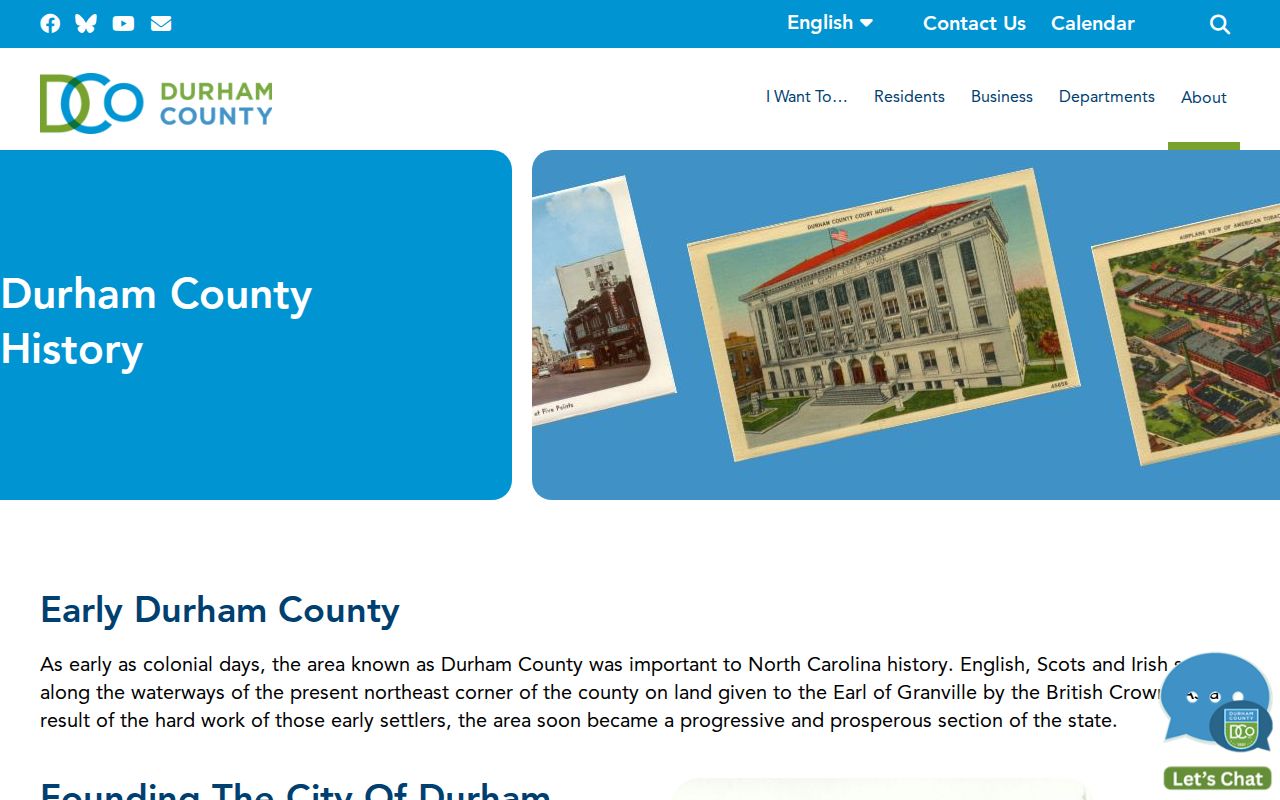
Reading the county date beside an early listing helps prevent a search from stopping at the wrong modern custodian.
Reading a Durham City Directory
A Durham city directory entry is useful because several small fields can be read together. Start with the printed name exactly as it appears, then preserve the edition year and page. A surname alone is weak for a common name. A street address, occupation or business line, and nearby street sequence can help separate people who share initials. The entry remains a statement made for that directory edition, so it needs corroboration before it is used to make a broader claim.
| Entry Field | How to Read It |
|---|---|
| Surname and given name or initials | Places the printed person in a specific edition; check variants and duplicate names. |
| Occupation or business | Records the directory's historical description, not a present credential or activity. |
| Street address | Supplies a reported location that may be residential, commercial, or a boarding arrangement. |
| Street section | Shows listings in the same address sequence or nearby portion of a street. |
| Telephone and edition | Anchors a later contact listing to its printed year; numbers can later be reassigned. |
- Criss-cross directory
- A directory arranged by street address, used to begin with a location instead of a surname.
- Householder index
- An alphabetical or household-oriented index that can point to the fuller listing in an edition.
- Abbreviation key
- The volume's guide to its shortened words and marks; photograph or note it before interpreting a line.
Copy uncertain punctuation and abbreviations exactly, then add a plain-language note beside the transcription. That preserves the Durham edition's wording while making the research trail readable later.
Walltown's Durham Directory Trail
Walltown is a useful example of why a directory should be read with maps, deeds, and a local plan. The Walltown Small Area Plan describes George Wall, a formerly enslaved Trinity College custodian, purchasing the plot at what is now 1015 Onslow Street. It also describes a predominantly Black neighborhood with blocks of roughly 24 lots, about 50 by 140 feet, and private 20-foot alleys. Much of the street grid remains, yet an alley or rear-lot address can make a modern map, directory, and deed appear inconsistent.
Durham's wider history also includes urban renewal that rerouted streets, demolished homes, and altered physical blocks in Hayti. A street may retain a legal name while its setting changes sharply. Read the directory street sequence beside the plan and recorded land material rather than equating a historical listing with a present occupant.
The City of Durham history page gives the local growth and neighborhood setting behind these changes.
The historical setting supplies context for a directory address without converting an old listing into a current residence claim.
Tracing Durham City Directory Households
Follow a household through more than one Durham city directory instead of treating a single appearance as the whole story. A surname can change from initials to a full name, a business can be listed at a different address, and a person can vanish for ordinary editorial reasons. Pairing the directory years with the relevant census decade can narrow the gap between federal snapshots. For a name that needs a modern record check, the Durham resident lookup provides a separate, one-person verification route.
- Choose a verified edition year and copy the surname, initials, address, page, and the volume's abbreviations.
- Check the same surname in the editions immediately before and after, including plausible spelling and initial variants.
- Turn to the street section for the recorded year and note the address sequence without assuming every neighbor is listed.
- Compare the time range with the applicable census, deed, newspaper, cemetery, yearbook, or institutional collection.
- Record the custodian, source URL or shelf location, edition date, and what each source actually establishes.
Note: A directory disappearance can mean a move, death, unlisted status, a changed name, or a missing edition, so it should lead to another source.
Checking a Durham Directory Listing
For a historical person, compare a Durham city directory listing with an independent record suited to the question. A recorded deed can identify instrument parties and a legal description; a cemetery record can establish an interment; a newspaper or manuscript can add social context; and a court or estate file can identify the role shown in that file. The Register of Deeds, Clerk, library, and archives each preserve different kinds of evidence. Do not make a property-ownership conclusion from an address line or a residence conclusion from a business listing.
The 1886 Tobacco Belt Directory deserves special care. Its asterisk is a source notation for Black businesses and landowners. Preserve that notation in a transcription and explain where it came from rather than silently changing it. The 1877/78 Beveridge directory, business advertisements, and later directory formats likewise have their own purposes and limits. Durham directories reward close reading because the collection is varied, not because every volume carries the same kind of proof.